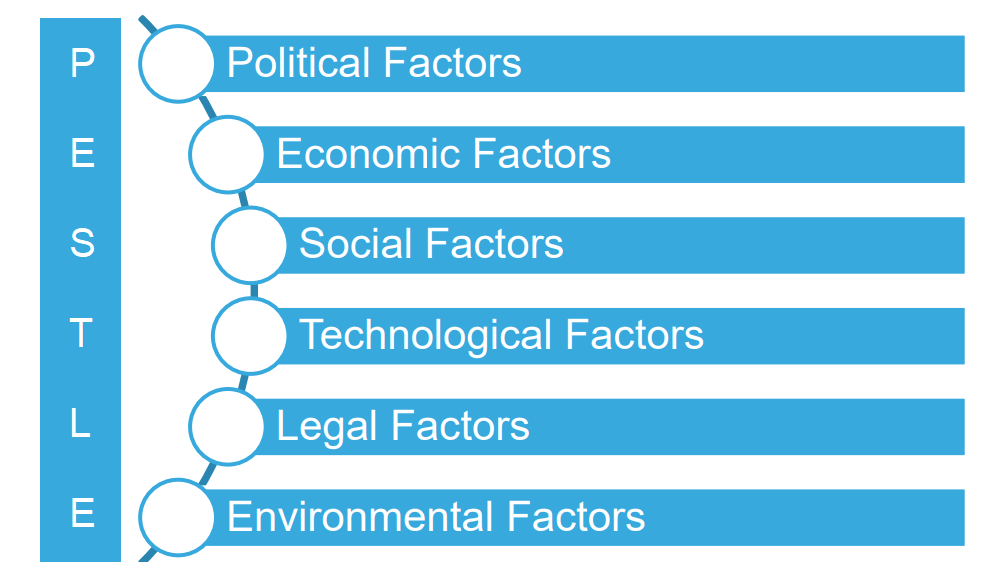
PESTLE analysis consists of components that influence the business environment and each letter in the acronym denotes a set of factors that directly or indirectly affect every industry. The Pestle analysis allows marketers to analyse the major environmental factors and examine the effect of these factors on marketing planning and implementation.
What is PESTLE / PESTEL / PEST Analysis?
Environmental influences can be thought of as layers around an organisation, with the outer layer making up the macro-environment, which can be analysed in terms of the PESTEL factors. A PESTEL analysis helps identify key drivers of change, which need to addressed in strategy; alternative scenarios can be constructed around key drivers.
PESTLE, acronym for political, economic, social, technological, legal and Environmental, is an analysis tool that allows businesses to assess various external factors that can influence its long-term operation and profitability in order to become more competitive in the market (Kotter and Schlesinger, 1991).
Francis Aguilar is the man behind this tool. The framework has undergone several iterations and factors like Legal and Environmental were added later to form the term PESTLE Analysis.
- Political: Government policy, Political stability, Corruption, Tax policy, Labor law, Trade restrictions
- Economic: Economic growth, Exchange rate, Interest rate, Inflation rates, Disposable income, Unemployment rates
- Social: Population growth rate, Age distribution, Career attitudes, Safety emphasis, Health consciousness, Lifestyle attitudes, Cultural barriers.
- Technology: Technology incentives, Level of innovation, Automation, R&D activity, Technological change, Technological awareness.
- Environmental: Weather, Climate, Environmental policies, Climate change, Pressures from NGOs
- Legal: Discrimination laws, Antitrust laws, Employment laws, Consumer protection laws, Copyright and patent laws. Health and safety laws.
PESTLE Analysis provides a top view of the whole environment so that you can effectively brainstorm a certain idea/plan.
Organisations need to consider:
- The market environment (e.g. suppliers, customers and competitors).
- The non-market environment (e.g. NGOs, Government, media and campaign groups).
PESTEL helps to provide a list of potentially important issues influencing strategy. It is important to assess the impact of each factor.
It helps identify threats and weaknesses which is then used in a SWOT analysis.
The various factors, mentioned in the PESTLE analysis, may affect different industries differently.
For example, economic factors are more important to companies that belong to the Banking sector, whereas companies in the tourism sector will care more for the Environmental factors.
PESTLE analysis helps businesses assess the external environmental factors and see how it affects the business (positively or negatively). Some of these factors may boost the fortunes of the company, and some may cause a decline in the company’s sales.
Irrespective, being aware of these factors is a necessity for all businesses out there as it helps in decision making and strategic planning. While it’s difficult to totally avoid the impact of external forces, companies can minimize the impact of such factors if they know about it beforehand.
Political Factors
Political factors can affect an organization’s operations or decision making. Unstable political regimes expose foreign businesses to various risks they may not face at home.
Government actions such as Operational restrictions (e.g. exchange controls or employment policies), Discriminatory restrictions (e.g. tariffs on certain imports), Physical actions (such as nationalization, riots and war) constitute potential risk for a firm.
More factors include: Current legislation in the home market. Future legislation – effects of BREXIT. International legislation – EU. Regulatory bodies and processes. Government policies. The industry has to follow the taxation policy, implement labor laws in industry, trade restrictions, political stability in the country, environmental laws and tariffs.
Government term and change. Political risk analysis is the analysis of threats and opportunities arising from potential political change. Trading policies. Funding, grants and initiatives. Home market lobbying/pressure groups. International pressure groups. Wars and conflicts.
Related: The Political Environment facing business
Economic Factors
Economic factors include: Business cycles. Interest rates. Personal disposable income. Exchange rates. Unemployment rates. Differential growth rates around the world. Economic factors can influence supply and demand of the product and substitute resources.
Economic developments, national policies, and issues that hinder growth, all these factors affect a marketing strategy. Firms must assess whether they can profitably satisfy market demand and compete with firms already in the market.
Emerging economies tend to have large populations with growing incomes which leads to growing consumer demand. One sees government directed economic reforms and improved infrastructure.
Least developed countries (LDCs), on the other hand, have low GDP per capita, limited manufacturing base, infrastructure weaknesses, and there are challenges in securing capital investment.
Related: The Economic Environment facing business
Social Factors
Operating effectively in different countries requires recognition that there may be considerable differences in different regions.
Social factors take into account the social fabric of the market. This element include things like demography, income migration, religion, culture, and ideological views on the issues. Important events, festivals, shopping habits, other social/cultural factors.
At the stage of early internationalization, it is not unusual for firms to experience what appear to be cultural gaps with their counterparts in the host countries (where they are expanding into).
On the other hand, there are visible signs that social and cultural differences are becoming less of a barrier due to the dominance of a number of world brands such as Bimbo, Natura, Samsung, or Louis Vuitton
However, it is important not to confuse globalization of brands with the homogenization of cultures.
Related: The Socio-Cultural Environment facing business
Technological Factors
Changes in technology can influence businesses and organizations may need to adopt modern technology, learn new techniques and use different methods.
Technological factors include new technology developments that can influence product development, marketing, process improvements, or help create new business models.
Innovation is vital for high-technology firms. Less technology-intensive firms may still require some innovation to improve product/service, processes or to rapidly adopt new products that competitors are offering.
Related: The Technological Environment facing business
Legal Factors
Legal systems are different in every country and it is the duty of a company to abide by national laws in all activities.
Legal factors include Labour, environmental and consumer regulations. Taxation and reporting requirements. Rules on ownership. Competition regulations. Regulation of corporate governance.
All these law-related factors could impact a business.
Related: The Legal Environment facing business
Environmental Factors
Ecological factors refer to ‘green’ or environmental issues, such as pollution, food, waste, temperature, climate change, population density. Examples are environmental protection regulations, energy problems, global warming, waste disposal and recycling. Factors include but are not limited to climate, weather, global changes in climate, etc.
In the 1990s, companies became concerned with the concept of ‘green’ marketing, and later in the 2000s with the concept of marketing sustainability. Increasingly, consumers are worried about the impact of companies on their ecological environments. They are demanding more ‘organic’ food, incorporating principles of better welfare for the animals they consume as food products and less interference with the natural processes of growing fruit and vegetables (e.g. the use of pesticides and chemical fertilizers).
Various ecological challenges that organisations may need to meet:
- Direct pollution obligations– minimising the production of pollutants; cleaning up and disposing of waste.
- Sustainable development – whether the product or service can be produced indefinitely into the future.
- Managing ecological issues throughout the organisation’s entire value chain and the whole life cycle of the firm’s products.
A company can adopt one of the following four different green marketing strategies:
Eco-efficiency – developing lower costs through organizational processes such as the promotion of resource productivity (e.g. energy efficiency) and better utilization of by-products.
Beyond compliance leadership – the adoption of a differentiation strategy through organizational processes such as certified schemes to demonstrate their ecological credentials, their environmental excellence, for example, the adoption of the UN Global Compact principles or other Environmental Management System (EMS) schemes and codes such as ISO14001.
Eco-branding – the differentiation of a firm’s products or services to promote environmental responsibility. Examples include Duchy Originals, the British Prince of Wales’ food brand, the Thai King Bhumipol’s Golden Place brand, or the Toyota Prius labelled as ‘mean but green’.
Environmental cost leadership – the offering of products and services that give greater environmental benefits at a lower price.
Useful Read: IBM and the smarter planet
Questions to Ask
What are some ecological trends that have or are occurring? What are we concerned about today than what we weren’t 10 years ago? i.e. environment, pollution, product packaging, ingredients, advertising etc.
What impact do you think these changes might have on your case study organisation?
Pros & Cons of PESTEL
Here are the advantages od using the PESTEL model:
- It is a simple framework that is easily understood
- It enables key opportunities & threats to be identified & managed
- It encourages the development of strategic thinking within organisations
- It enables organisations to assess implications of entering new markets – both domestic & global markets
- It can also be used to identify trends
Here are some of the disadvantages of the PESTEL model:
- It focuses more on the current situation and may not consider long-term issues
- The analysis is a “snapshot in time” & can become out of date quickly
- It can generate long lists so it must be applied selectively for the applicable market or industry
- Relevant external information may not be accessible by the organisation
- Assumptions often form the basis for most of the data used, making any decision made based on such data subjective
PESTLE Examples
PESTLE analysis for Giordano
Giordano is a popular apparel retailer of apparel in the Asia Pacific region with shops operating in over 30 countries worldwide.
Political
Impact of events that can cause business disruption, changes to tax structure. How easy is to setup a manufacturing plant, or a store – bureaucracy, licenses. For example, anti-extradition protests in Hongkong had crippled the city during the second half of last year, when Giordano shops were vandalized and many were forced to close during police operations (Jeff Pao, 2020). Sales performance were also impacted due to Sino-US trade dispute.
Economical
Coronavirus has impacted sales as people are confined indoors (Jeff Pao, 2020). Labour costs can put pressure on margins. Increase in cost of raw materials, currency exchange rates are other factors that can impact business. A weak economy also discourages people to spend on apparel.
Social
Social factors include cultural influences, local tastes and preferences. Do people wear reserved clothing most of the time? Do they wear skimpy clothes? More factors include demographics of the population, class structure, education levels.
Technological
Technology related innovation can affect operations and the market. Giordana is enhancing its e-commerce capabilities to cater to consumers who prefer shopping (Michael Arnold, 2020). Digital and social marketing efforts will also help the company build brand loyalty.
Legal
Companies whose business spans multiple countries have to adhere to the legal laws of the countries within which it operates. So, Giordano will have to adhere to the labour laws, environmental laws, and other laws of countries where it is present.
Environmental
Environmental factors have become more important in recent times as people become more conscious about protecting the environment. Committed to minimizing the environmental impact due to its operations, Giordano will be using energy efficient lighting solutions in all its new stores (Giordano, 2020).
PESTLE Analysis for Oil & Petroleum Industry
The Oil & Petroleum industry plays an important role in the economy of a country and also gives good opportunity to investors. PESTLE Analysis would help to understand the nature of the working, the conditions of business and necessary regulations.
Political Factors: The industry has to follow the taxation policy, implement labor laws in industry, trade restrictions, political stability in the country, environmental laws and tariffs. Government also supports this industry and helps it to flourish so that it can contribute to the economy.
Economic Factors: These factors have the influence of the supply and demand of the oil prices along with supplementary goods, substitute resources and the exchange rate of American dollar in the market.
Social Factors: This include the demography, income migration, religion, culture, and ideological views on the issues. Skilled and professional workers work in this sector get good wages and relaxing working hours. The countries want to have oil and gas industry, so that they can meet their future demands and it can help them to raise their living standards.
Technological Factors: Changes in technology can influence the organization with the need to get modern technology, learn new techniques and use different methods. The latest technologies are used for the exploration of oil and gas and use roads, pipelines, transport and oil tanks. This industry is working for the complementary products, like synthetic fibers, and various other products. Substitute industries are introduced like biomass industry, nuclear industry, natural gas, coal industry, renewable energy resources and nuclear industry.
Legal Factors: There is formation of laws, rules and regulations of concerned department, governments and the international organizations and communities including European Union, African Union, North American Free Trade Agreement, ASEAN are included. The legal factor influences the exploration, exploitation, and the commercialization of oil products. There are legal obligations like work regulation, work protection, social protection, competition regulation, pollution, international trade and consumer protection. Further this industry has to pay the subsidies, taxes for fuels and oil prices etc.
Ecological / Environmental Factors: The geographic position of the oil reserves and refinery has great influence on the activity of the oil companies. The latest report of OPEC shows that most of the natural oil and petroleum is produced in the countries like Saudi Arabia, Kuwait, Russia, US, Iran, Canada etc., they have to face natural disasters like earthquakes, hurricanes, cyclones, tsunami that affect the economic situation in the country. The Government should ensure strict regulations for the use of oil and gas to combat with the negative effects of oil and gas industry as well as design the structure to utilize these resources in preventive and safe manner.
PEST Analysis for Decathlon India
- Political: In India, Decathlon business operations won’t be disrupted due to civil unrest, government regulations. The business environment in India is also conducive for foreign entrants.
- Economic: The Indian market provides easy availability of capital, and the middle class has good disposable incomes in India
- Social: More people in India are indulging in fitness and sports activities. Advertisements should be sensitive towards Indian culture.
- Technology: More people are buying products online. Mobile payment is popular in India
References
Kotter, J. and Schlesinger, L. (1991) “Choosing strategies for change” Harvard Business Review, pp.24-29

Leave a Reply